Chrysalis Angel

Chrysalis Angel
Becoming an Angel is the work of humans.

CHRYSALIS WELCOMES EVERYONE

Chrysalis' year begins the first Sunday after Labor Day in September. Services are held each Sunday at 10AM to 12 Noon. There will be no services held during August 2014. First meeting in the fall will be September 7, 2014.

Sunday Services from 10 am to 11:30 am each week
805 Mercer's Fernery Road
DeLand, FL (the white 2 story farm house)
Pastor - Skuli Thorhallsson

For more information or counseling phone (386) 478-9201

Email questions or requests to chrysalisgarden@gmail.com

Chrysalis Spiritual Center is a Swedenborg based congregation that studies non-deno
minational topics based on the value of certain writings and speech to society as a whole. Services are frequently presented by guest speakers. No denomination is excluded from meeting with us. We welcome all religions, ages, genders and beliefs.

Saturday, August 20, 2011

COMEDY CLUB


IT'S TIME FOR COMEDY CAMP IMPROV WORKSHOP
Sundays - Aug. 7 to Sept. 11
12 Noon - 3:00 PM 
at PVCSL $10 suggested donation per class

Learn improv techniques used by Steve Carell, Tina Fey, Robin Williams, Paul Rudd, Stephen Colbert and more!  
       For more information, contact Rev. Lynn at  (818) 620-8592.   

Comedy Camp is sponsored the the Pleasant Valley Center for Spiritual Living in California. Rev. Lynn is Flitter editor's sister. 

It is a long trip, but would be a nice vaca if you want to improve your life with humor and happiness. Lynn has been a professional actor, dancer and performer on Broadway, in film and TV for 30 years. She originally studied as a classical ballet performer and studied with several noted ballet schools. She has appeared on Broadway in (among others), Coco, and Cabaret, and at the World's Fair in Montreal in Hellzapoppin'.  

Lynn and her husband are owners of Capers, a mystery weekend event supplier for corporations around the world. Capers is a repetoire company with all original script scenarios written by Rev. Lynn and Buzz Noe. One of their plays is called "Dead and Breakfast." 

They do have a lot of fun with life.

Tuesday, July 19, 2011

A UNIVERSE OF PARALLELS

Affirmation

I bravely accept difficult situations in my life. I realize moving through these situations will ultimately open something new and wonderful for me. I am a better person for my life experiences. And so it is.


One is a neuron. The other is the structure of the universe.

link shared by Dharmachakra


Originally printed in the New York Times, here's the text printed over and under these images:


One is only micrometers wide. The other is billions of light-years across. One shows neurons in a mouse brain. The other is a simulated image of the universe. Together they suggest the surprisingly similar patterns found in vastly different natural phenomena.

Mark Miller, a doctoral student at Brandeis University, is researching how particular types of neurons in the brain are connected to one another. The image [on the left] shows three neuron cells on the left (two red and one yellow) and their connections.


An international group of astrophysicists used a computer simulation last year to recreate how the universe grew and evolved. The simulation image [on the right]  is a snapshot of the present universes that features a large cluster of galaxies (bright yellow) surrounded by thousands of stars, galaxies and dark matter (web).
What struck me about this is not the similarity between neuron and universe, though it's striking — rather it's the continuity of parallels one finds whenever one looks into the structures of nature.

From Hermetics to the Tao of Physics — A Universe of Parallels

"As above, so below," goes the Hermetic belief — "That which is Below corresponds to that which is Above, and that which is Above, corresponds to that which is Below, to accomplish the miracles of the One Thing". In Eastern thought, this idea is often paraphrased as "As is the microcosm, so is the microcosm."

I first came across these concepts in my reading of The Tao of Physics. Fritjof Capra's classic opened the eyes of many in the west — and helped spawn the New Age movement — by detailing the close, often uncanny parallels between Eastern, metaphysical cosmology and the furthest reaches of western, theoretical physics.

Capra was derided by some scientists as superficial and misleading, yet he had his allies among the luminaries of physics. Interviewed by Renee Weber in the book The Holographic Paradigm, Capra describes his discussions with Werner Heisenberg:

I had several discussions with Heisenberg. I lived in England then [circa 1972], and I visited him several times in Munich and showed him the whole manuscript [of The Tao of Physics] chapter by chapter. He was very interested and very open, and he told me something that I think is not known publicly because he never published it. He said that he was well aware of these parallels. While he was working on quantum theory he went to India to lecture and was a guest of [poet Rabindrinath] Tagore. He talked a lot with Tagore about Indian philosophy. Heisenberg told me that these talks had helped him a lot with his work in physics, because they showed him that all these new ideas in quantum physics were in fact not all that crazy. He realized there was, in fact, a whole culture that subscribed to very similar ideas. Heisenberg said that this was a great help for him. Niels Bohr had a similar experience when he went to China.
Subjective and Objective, Physiology and Veda
My own explorations on the subject have come not from the objectivist tradition of western science, but rather from many years practicing meditation and studying the Upanishads and other Vedic literature — exploring a consciousness-centered paradigm, you might say. I have also seen some very interesting conversations between Maharishi Mahesh Yogi (founder of the Transcendental Meditation movement) and leading scientists such as Ilya Prigogene, the "human thermodynamics" pioneer.

Over the course of his career, Maharishi pushed to validate the subjectively derived insights of meditation through western science. He would button any Nobel laureate within reach, attempting to ground the discoveries and theories of physics, chemistry and biology in Vedic structures of reality. Maharishi eventually commissioned MIT research physician Tony Nader to locate the entire structure of Vedic literature in the brain physiology and central nervous system. Nader published his insights as Human Physiology: Expression of the Veda and Vedic Literature.


In one of the more fanciful sections of the book, Nader even finds a close resemblance between the shape of the hippocampus — responsible for memory forming, organizing, and storing — and images of the elephant-headed god Ganesh, the deva of intellect and wisdom.


In the Chinese tradition (to pick almost at random from the analogs found in the mythos of ancient civilization) physical and mathematical structures like chaos also seem clearly laid out:

Chaos is the supreme ideal of Taoism. Chaos is wholeness, oneness and Nature. Chaos represents the natural state of the world. Digging holes on the head of Chaos means destroying the natural state of the cosmos. Therefore, to the ancient Chinese people chaos not only has the meaning of disorder but also presents a respectable aesthetic state. This idea of chaos may be very different from its western counterpart.

(From "A Brief History of the Concept of Chaos" — Huajie Liu, Department of Philosophy, Peking University)

Given all of which, it should hardly be surprising that a neuron (microcosm) should resemble the universe (macrocosm). While modern science has been a little slow to concede the chain of parallels, one can almost see the ancient rishis rolling their eyes and saying, "Duh!"

________________________________________________

“Be not afraid of growing slowly, be afraid only of standing still” Chinese Proverb

________________________________________________

Psychological (“personality”) Types

According to Jung’s theory of Psychological Types we are all different in fundamental ways. One’s ability to process different information is limited by their particular type. These types are sixteen.

People can be either Extroverts or Introverts, depending on the direction of their activity; Thinking, Feeling, Sensing, Intuitive, according to their own information pathways; Judging or Perceiving, depending on the method in which they process received information.

Extroverts vs. Introverts

Extroverts are directed towards the objective world whereas Introverts are directed towards the subjective world. The most common differences between Extroverts and Introverts are shown below:

Extroverts

    are interested in what is happening around them
    are open and often talkative
    compare their own opinions with the opinions of others
    like action and initiative
    easily make new friends or adapt to a new group
    say what they think
    are interested in new people
    easily break unwanted relations

    Introverts

    are interested in their own thoughts and feelings
    need to have own territory
    often appear reserved, quiet and thoughtful
    usually do not have many friends
    have difficulties in making new contacts
    like concentration and quiet
    do not like unexpected visits and therefore do not make them
    work well alone


Sensing vs. Intuition

Sensing is an ability to deal with information on the basis of its physical qualities and its affection by other information. Intuition is an ability to deal with the information on the basis of its hidden potential and its possible existence. The most common differences between Sensing and Intuitive types are shown below:

Sensing types

    see everyone and sense everything
    live in the here and now
    quickly adapt to any situation
    like pleasures based on physical sensation
    are practical and active
    are realistic and self-confident

    Intuitive types

    are mostly in the past or in the future
    worry about the future more than the present
    are interested in everything new and unusual
    do not like routine
    are attracted more to the theory than the practice
    often have doubts


Thinking vs. Feeling

Thinking is an ability to deal with information on the basis of its structure and its function. Feeling is an ability to deal with information on the basis of its initial energetic condition and its interactions. The most common differences between Thinking and Feeling type are shown below:

Thinking types

    are interested in systems, structures, patterns
    expose everything to logical analysis
    are relatively cold and unemotional
    evaluate things by intellect and right or wrong
    have difficulties talking about feelings
    do not like to clear up arguments or quarrels

Feeling types

    are interested in people and their feelings
    easily pass their own moods to others
    pay great attention to love and passion
    evaluate things by ethics and good or bad
    can be touchy or use emotional manipulation
    often give compliments to please people


Perceiving vs. Judging

Perceiving types are motivated into activity by the changes in a situation. Judging types are motivated into activity by their decisions resulting from the changes in a situation. The most common differences between Perceiving and Judging types are shown below:

Perceiving types

    act impulsively following the situation
    can start many things at once without finishing them properly
    prefer to have freedom from obligations
    are curious and like a fresh look at things
    work productivity depends on their mood
    often act without any preparation

    Judging types

    do not like to leave unanswered questions
    plan work ahead and tend to finish it
    do not like to change their decisions
    have relatively stable workability
    easily follow rules and discipline


These four opposite pairs of preferences define eight different ways of dealing with information, which in turn result in sixteen Psychological Types:

_________________________________________________


 Book Report
from Parabola newsletter

Rumi and the Whirling Dervishes


This book, beautifully illustrated with rare photographs of dervishes, tells the tale of the Sufi order and its founder, poet and mystic Mevlana Jalalu’ddin Rumi. After Rumi’s death in 1273, the whirling dance or sema was established as part of the Mevlevi’s prayer ritual, and it has been performed by them ever since. The sema survives to this day, a statement of a timeless and passionate yearning toward God. With a special section devoted to Mevlevi music, and introductions by Annemarie Schimmel and Seyyed Hossein Nasr, Rumi and the Whirling Dervishes offers an unparalleled glimpse into the Mevlevi’s ecstatic practices. A beautiful companion for Friedlander’s film Rumi: The Wings of Love Paperback; 165 pp.; 90 duotone photographs. $15.95 $7.98


“Giving, receiving,
Transmitting, transforming,
Man’s body mediates
Energies on every level.”

—William Segal
____________________________________________________

Prayer of Invocation

From the point of Light within the Mind of God
Let light stream forth into the minds of men.
Let Light descend on Earth.

From the point of Love within the Heart of God
Let love stream forth into the hearts of men.
May Christ return to Earth.

From the centre where the Will of God is known
Let purpose guide the little wills of men --
The purpose which the Masters know and serve.

From the centre which we call the race of men
Let the Plan of Love and Light work out.
And may it seal the door where evil dwells.

Let Light and Love and Power
restore the Plan on Earth.
the great invocation

-- maitreya
______________________________________________________

The end of all our exploring will be to arrive where we started and know the place for the first time. 

                                               T. S. Eliot


Saturday, June 25, 2011

EARTH IS FULL


"The world is so full of a number of things,
I'm sure we should all be as happy as kings!"
"A Child's Garden of Verses" Robert Lewis Stevenson


You really do have to wonder whether a few years from now we’ll look back at the first decade of the 21st century — when food prices spiked, energy prices soared, world population surged, tornadoes plowed through cities, floods and droughts set records, populations were displaced and governments were threatened by the confluence of it all — and ask ourselves: What were we thinking? How did we not panic when the evidence was so obvious that we’d crossed some growth/climate/natural resource/population red-lines all at once?
Josh Haner/The New York Times


 “The only answer can be denial,” argues Paul Gilding, the veteran Australian environmentalist-entrepreneur, who described this moment in a new book called “The Great Disruption: Why the Climate Crisis Will Bring On the End of Shopping and the Birth of a New World.” “When you are surrounded by something so big that requires you to change everything about the way you think and see the world, then denial is the natural response. But the longer we wait, the bigger the response required.”

Gilding cites the work of the Global Footprint Network, an alliance of scientists, which calculates how many “planet Earths” we need to sustain our current growth rates. G.F.N. measures how much land and water area we need to produce the resources we consume and absorb our waste, using prevailing technology. On the whole, says G.F.N., we are currently growing at a rate that is using up the Earth’s resources far faster than they can be sustainably replenished, so we are eating into the future. Right now, global growth is using about 1.5 Earths. “Having only one planet makes this a rather significant problem,” says Gilding.

This is not science fiction. This is what happens when our system of growth and the system of nature hit the wall at once. While in Yemen last year, I saw a tanker truck delivering water in the capital, Sana. Why? Because Sana could be the first big city in the world to run out of water, within a decade. That is what happens when one generation in one country lives at 150 percent of sustainable capacity.

“If you cut down more trees than you grow, you run out of trees,” writes Gilding. “If you put additional nitrogen into a water system, you change the type and quantity of life that water can support. If you thicken the Earth’s CO2 blanket, the Earth gets warmer. If you do all these and many more things at once, you change the way the whole system of planet Earth behaves, with social, economic, and life support impacts. This is not speculation; this is high school science.”

It is also current affairs. “In China’s thousands of years of civilization, the conflict between humankind and nature has never been as serious as it is today,” China’s environment minister, Zhou Shengxian, said recently. “The depletion, deterioration and exhaustion of resources and the worsening ecological environment have become bottlenecks and grave impediments to the nation’s economic and social development.” What China’s minister is telling us, says Gilding, is that “the Earth is full. We are now using so many resources and putting out so much waste into the Earth that we have reached some kind of limit, given current technologies. The economy is going to have to get smaller in terms of physical impact.”

We will not change systems, though, without a crisis. But don’t worry, we’re getting there.

We’re currently caught in two loops: One is that more population growth and more global warming together are pushing up food prices; rising food prices cause political instability in the Middle East, which leads to higher oil prices, which leads to higher food prices, which leads to more instability. At the same time, improved productivity means fewer people are needed in every factory to produce more stuff. So if we want to have more jobs, we need more factories. More factories making more stuff make more global warming, and that is where the two loops meet.

But Gilding is actually an eco-optimist. As the impact of the imminent Great Disruption hits us, he says, “our response will be proportionally dramatic, mobilizing as we do in war. We will change at a scale and speed we can barely imagine today, completely transforming our economy, including our energy and transport industries, in just a few short decades.”

We will realize, he predicts, that the consumer-driven growth model is broken and we have to move to a more happiness-driven growth model, based on people working less and owning less. “How many people,” Gilding asks, “lie on their death bed and say, ‘I wish I had worked harder or built more shareholder value,’ and how many say, ‘I wish I had gone to more ballgames, read more books to my kids, taken more walks?’ To do that, you need a growth model based on giving people more time to enjoy life, but with less stuff.” Sounds utopian? Gilding insists he is a realist.

“We are heading for a crisis-driven choice,” he says. “We either allow collapse to overtake us or develop a new sustainable economic model. We will choose the latter. We may be slow, but we’re not stupid.”


“Existence leans its mouth
toward me,
because my love
cares for
it.”

—Meister Eckhart.  By way of Love is a Place.

Hopi Elder
Latest tracks by dreaming in the void blog


---------------------------------------------------------------------------------------------------------


Keep your hands
Open, and
All the sands
Of the desert can
Pass through them.

Close them, and
All you can feel
Is a bit of grit.
Taisen Deshimaru, “Attachment”


Everything you give, you get back, times seven.
Plus, what you give, grows, times seven. Plus plus, there’s a little known intergalactic algorithm that states whenever love is added to the giving, your desires draw ever closer to the giver.    
 Whoa! The Universe

A FRESH LOOK AT AN OLD POEM

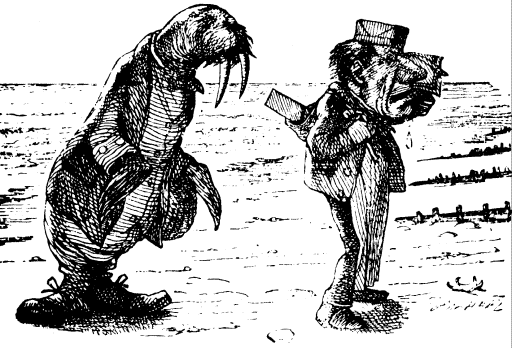
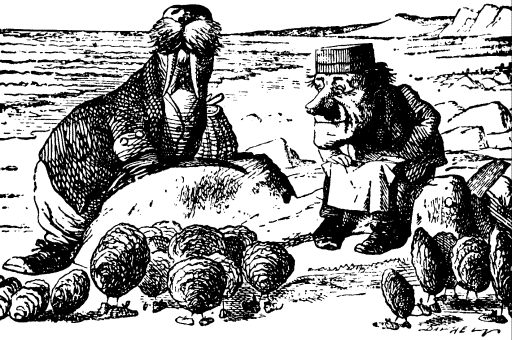
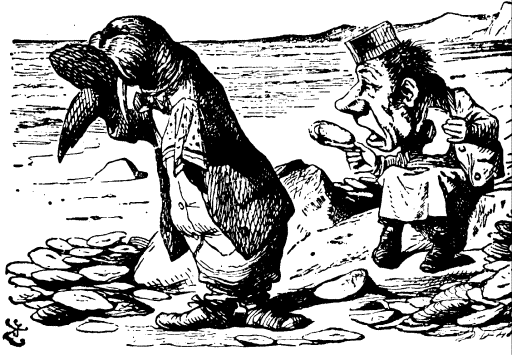
The Walrus and The Carpenter


from Through the Looking-Glass and What Alice Found There, 1872   Lewis Carroll

The sun was shining on the sea,
Shining with all his might:
He did his very best to make
The billows smooth and bright--
And this was odd, because it was
The middle of the night.


The moon was shining sulkily,
Because she thought the sun
Had got no business to be there
After the day was done--
"It's very rude of him," she said,
"To come and spoil the fun!"


The sea was wet as wet could be,
The sands were dry as dry.
You could not see a cloud, because
No cloud was in the sky:
No birds were flying overhead--
There were no birds to fly.


The Walrus and the Carpenter
Were walking close at hand;
They wept like anything to see
Such quantities of sand:
"If this were only cleared away,"
They said, "it would be grand!"


"If seven maids with seven mops
Swept it for half a year.
Do you suppose," the Walrus said,
"That they could get it clear?"
"I doubt it," said the Carpenter,
And shed a bitter tear.


"O Oysters, come and walk with us!"
The Walrus did beseech.
"A pleasant walk, a pleasant talk,
Along the briny beach:
We cannot do with more than four,
To give a hand to each."


The eldest Oyster looked at him,
But never a word he said:
The eldest Oyster winked his eye,
And shook his heavy head--
Meaning to say he did not choose
To leave the oyster-bed.


But four young Oysters hurried up,
All eager for the treat:
Their coats were brushed, their faces washed,
Their shoes were clean and neat--
And this was odd, because, you know,
They hadn't any feet.


Four other Oysters followed them,
And yet another four;
And thick and fast they came at last,
And more, and more, and more--
All hopping through the frothy waves,
And scrambling to the shore.


The Walrus and the Carpenter
Walked on a mile or so,
And then they rested on a rock
Conveniently low:
And all the little Oysters stood
And waited in a row.


"The time has come," the Walrus said,
"To talk of many things:
Of shoes--and ships--and sealing-wax--
Of cabbages--and kings--
And why the sea is boiling hot--
And whether pigs have wings."


"But wait a bit," the Oysters cried,
"Before we have our chat;
For some of us are out of breath,
And all of us are fat!"
"No hurry!" said the Carpenter.
They thanked him much for that.


"A loaf of bread," the Walrus said,
"Is what we chiefly need:
Pepper and vinegar besides
Are very good indeed--
Now if you're ready, Oysters dear,
We can begin to feed."


"But not on us!" the Oysters cried,
Turning a little blue.
"After such kindness, that would be
A dismal thing to do!"
"The night is fine," the Walrus said.
"Do you admire the view?


"It was so kind of you to come!
And you are very nice!"
The Carpenter said nothing but
"Cut us another slice:
I wish you were not quite so deaf--
I've had to ask you twice!"


"It seems a shame," the Walrus said,
"To play them such a trick,
After we've brought them out so far,
And made them trot so quick!"
The Carpenter said nothing but
"The butter's spread too thick!"


"I weep for you," the Walrus said:
"I deeply sympathize."
With sobs and tears he sorted out
Those of the largest size,
Holding his pocket-handkerchief
Before his streaming eyes.


"O Oysters," said the Carpenter,
"You've had a pleasant run!
Shall we be trotting home again?'
But answer came there none--
And this was scarcely odd, because
They'd eaten every one.

NAMASTE


Chrysalis Spiritual Center


Wednesday, June 1, 2011

Thoughts, Grief, Gay Funerals,

 
 Om bhurbhuvah swah tatsaviturvarenyam
bhargo devaasya dhimahi dhiyo yonah prachodayat

Oh Almighty!
We meditate upon the adorable radiant, the divine sun!
May he unfold and give direction to our intellects
to go on the right path!
rigveda 3:62:10 - 4000 b.c.e. ±


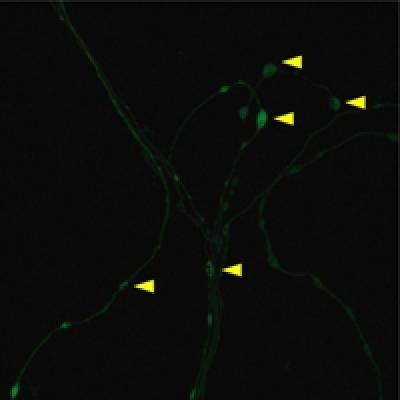
The increase in green fluorescence represents the imaging of local translation at synapses during long-term synaptic plasticity. (Photo Credit: Science)
Birth of a Thought

The ability to learn and to establish new memories is essential to our daily existence and identity; enabling us to navigate through the world. A new study by researchers at the Montreal Neurological Institute and Hospital (The Neuro), McGill University and University of California, Los Angeles has captured an image for the first time of a mechanism, specifically protein translation, which underlies long-term memory formation. The finding provides the first visual evidence that when a new memory is formed new proteins are made locally at the synapse - the connection between nerve cells - increasing the strength of the synaptic connection and reinforcing the memory. The study published in Science, is important for understanding how memory traces are created and the ability to monitor it in real time will allow a detailed understanding of how memories are formed.

When considering what might be going on in the brain at a molecular level two essential properties of memory need to be taken into account. First, because a lot of information needs to be maintained over a long time there has to be some degree of stability. Second, to allow for learning and adaptation the system also needs to be highly flexible.

For this reason, research has focused on synapses which are the main site of exchange and storage in the brain. They form a vast but also constantly fluctuating network of connections whose ability to change and adapt, called synaptic plasticity, may be the fundamental basis of learning and memory.

"But, if this network is constantly changing, the question is how do memories stay put, how are they formed? It has been known for some time that an important step in long-term memory formation is "translation", or the production, of new proteins locally at the synapse, strengthening the synaptic connection in the reinforcement of a memory, which until now has never been imaged," says Dr. Wayne Sossin, neuroscientist at The Neuro and co-investigator in the study. "Using a translational reporter, a fluorescent protein that can be easily detected and tracked, we directly visualized the increased local translation, or protein synthesis, during memory formation. Importantly, this translation was synapse-specific and it required activation of the post-synaptic cell, showing that this step required cooperation between the pre and post-synaptic compartments, the parts of the two neurons that meet at the synapse. Thus highly regulated local translation occurs at synapses during long-term plasticity and requires trans-synaptic signals."


Long-term memory and synaptic plasticity require changes in gene expression and yet can occur in a synapse-specific manner. This study provides evidence that a mechanism that mediates this gene expression during neuronal plasticity involves regulated translation of localized mRNA at stimulated synapses. These findings are instrumental in establishing the molecular processes involved in long-term memory formation and provide insight into diseases involving memory impairment.

This study was funded by the National Institutes of Health, the WM Keck Foundation and the Canadian Institutes of Health Research.


Existential Grief

We are all made of energies. Some, such as auras, are so subtle few people can sense them. Others are so gross they have turned into muscle and bone. Humans seem to have a number of different energies. The most vital of these, the one that gave us our birth, so to speak, and the powerful quality of aliveness in every creature, is the lifeforce. Another, the kundalini, is the bridge connecting the lifeforce to the spirit, just as the soul connects the ego to spirit. Mind contains other forms of energy, as do our emotions - and there is essence.

Essence belongs to all living creatures. They are born with it. The experience of essence cannot be adequately described in words, but it is unmistakable. Essence can be sensed in qualities such as will, joy, strength and love. It has presence. We feel authentic and at home in our world. Hanging out, touching a leaf, making love - all the everyday things - take on a deeper significance. With essence life is calm and steady, without emotional drama. It is a felt experience, but not a feeling. It is pure pleasure. It is our nature.

A cat has essence, beingness, spaciousness and all those other qualities which characterise a natural organism. It is gifted with this in its birth, as we are. But a cat lacks self-awareness. It has not the capacity to transcend itself in order to raise its consciousness to a higher level. When we reconnect with essence we connect once again with our original level of being at birth. But essence cannot take us higher without a conscious connection to the soul, for only another spiritual energy can be the bridge to the Self, and essence is not a spiritual force. If we have retained some contact with our soul, reclaiming essence can bring the two together again; but, if we have lost our soul altogether, essence may not on its own bring it back.

Essence is enlivened by the lifeforce, which is the energy of our daily vitality. The lifeforce is a separate entity and we are the vessel through which it flows. An abundance of lifeforce is the foundation of spiritual work. Unrestricted, it brings pleasure and open curiosity and high energy - just those qualities least tolerated by our parents.

At birth, essence and lifeforce are flowing naturally within an unrestricted inner spaciousness where there are no blocks or closures to impede it. In this sense we are empty inside. It is not that there is nothing going on, but rather that the flow of energy is so free and unimpeded we seem to contain a natural emptiness through which life and essence moves. We feel hugely spacious. It is like the wind blowing through the trees: the air and the trees exist, yet there is space around and between that allows the breeze to pass this way and that.

The induction of energetic nodes and the pain of separation begin to block these breezes. Suppressing the normal ebullience of our lifeforce blocks the winds even more. Under constant pressure from our parents to conform to their roles and images we tie ourselves down in the hope of pleasing them. We become full of sadness that we have died to who we are. Easeful space turns into a black emptiness. Part of us may wish to die in body as we have died inside, often leading to sickness and physical weakness. How many truly mourned this loss at the time? It only takes the death of someone we love to trigger a deep pool of utter grief that feels as if it has been lying in wait for this moment. We had hidden it, for if we had let ourselves truly grieve for our own inner death we would have been alive in that moment - but that moment would have been too painful for us and our parents to allow without restricting in some way. This is called existential grief, the unbearable sorrow at our loss of what gave us our existence in the first place. Shutting it off also shuts down some part of our humanity.

By the age of four most of us will have accommodated to this loss, and be well on the way to replacing essence with ego. Our capacity to do this stems from those qualities which raised us above the rest of creation - our unique ability as a child for self-reflection and self-modification which could monitor our behaviour and change it. The blessing is it will be the same qualities that can lead us back again. Our cross is also our gift.

For example, true will - the natural inborn strength and cohesiveness that is expressed in every baby - was trodden on by parents who could not stand the noise, the importunity, or even the utter truthfulness this will brought to life. So the infant replaced it with a more acceptable if artificial will which kept the peace and the hope for some of mother’s love.

Similarly with the lifeforce. Adults generally fear that the lifeforce in their children will overpower them - mirroring that they were themselves overpowered by parents who could not abide their exuberance. Being constantly hushed, nearly all of us decided from a very early age that it would be safer to be compliant and pleasing than be ourselves. So we put great energy into suppressing the lifeforce and our bodies are tired out by the effort, giving us permission to be as dead as the adults.

From this comes shame that our deepest vitality is hated and our essential nature is unacceptable to those we love most. Blocking the lifeforce is painful. The ego transforms this pain into the denial of self-worth T S Elliot called “the cancer that eats away the soul”. It is one root of the terrible fear that we are flawed - fundamentally and eternally. The resulting loss of confidence spreads emptiness over everything until we are lost in it. Emptiness becomes equated with uncertainty. Yet this emptiness is the home of just those qualities of unrestricted spaciousness that would most capably support us in dealing with the loss.

Pat recalled the very satisfactory feeling of emptiness he had as a baby which came with shitting and pissing, in the easy flowing out and the release of pressure. But at the same time his bowls reacted to his mother’s anxiety with a feeling of loss that was also an emptiness - the existential emptiness from loss of self. He began to link the two feelings. Voiding his bowls felt like his essence was flowing out leaving him both physically and emotionally empty, especially around the genitals. As sexual feelings were added to these nodes he came to long for this hole to be filled sexually.

As we lose essence and restrict our lifeforce we create false qualities to take their place. Paradoxically, we then feel pleasure in restricting ourselves. This strange situation arises because the lifeforce cannot be killed, but instead turns negative. As we are using the very energy of the lifeforce to block itself, the pleasure inherent in this force always remains hidden just beneath the surface. Because pleasure and life are one and the same, when pleasure is linked to destructiveness, destructiveness cannot be given up - it feels as if life itself were being given up. Thus the widespread guilt that accompanies most of our pleasures and numbs our feelings.

This is why we cannot use affirmations or meditations to replace negative feelings with positive ones. Negativities have to be converted back to their original free state by feeling the pleasure in the unpleasure. Trying to replace destructive feelings with positive ones merely pushes the negativity deeper into the shadow.

The state of our lifeforce and psychic nodes is reflected in our chakras. These are spots in the body where distorted or polluted energies collect. They may appear as shafts of light, spinning wheels or bursts of energy to those who can see them. Different cultures count them in different ways and assign different qualities to them. The West has, on the whole, accepted the Indian chakra system where there are seven centres from the groin to the crown of the head. The more primitive and instinctual components are at the bottom and the higher, that connect us to the Spirit, are at the top. As we clear and purify the emotional and physical bodies the chakras also become clear and, as the journey proceeds, they disappear altogether.

Aligned with the lifeforce, but separate from it, is the kundalini. This is the bridge between life’s vitality and the spiritual realm. It is a massive force, huge and ungovernable that, well handled, will scarify the energy systems of the body. The kundalini is the presence of God within our lifeforce, and in Indian lore it resides at the base of the spine, coiled like a serpent waiting to arise. But if we have the kundalini before we are prepared, we are sending 5000 volts through a 120 volt wire. It can be a terrible experience: do not wish for it until you are already well on the journey, for it won’t necessarily leave you better off. It is an energy that should be guided and encouraged in small quantities, when it can be highly beneficial and transformative.

To steady itself against emptiness and negativity the ego develops boundaries. They may be very open or tough as steel. They may collapse when a loved one is nearby, leaving you too personable and vulnerable, or they may grow thorns to prick any who approach too closely. Whatever its final form, the boundary protects the child from his own emptiness. This is where ambivalence is born. On the one hand he avoids his emptiness by strengthening ego-based boundaries and, on the other, he yearns for the promise of beingness and oneness that emptiness contains. Thus he is at one and the same time creating and demolishing his own framework. This is both exhausting and dispiriting.

Boundaries should be affirmed and consolidated, so we are able to direct their strength and porosity at will. Then, as we gain more of our original qualities back and our natural spaciousness moves into consciousness, the need for an outer barrier is replaced by an inner solidity and serenity.

Loss of essence and lifeforce need not be permanent. They are only in hiding. Removing the blocks has a huge effect on our lives: we are filled with pleasure and there is no fear. When the lifeforce is strong we exist, and then the other exists also. Nothing that comes from the pleasure current can do us ill.

To heal the emptiness we remind the inner child of what it knew but has forgotten. Whenever we can embody subtle impressions so they achieve the same reality they had when we were young, there will be deep changes. We do this by using our senses to make the hollow more tangible and, if we can bear to stay with the experience, by bringing our full awareness to the emptiness. Then negativity changes to something positive and a spaciousness may appear. Almaas describes how “space eliminates our defences, our identification with personality. Then essence unfolds and flowers in its various beautiful manifestations. Filling and bathing our sexual area, this essence allows us to feel rooted in its beauty and certainty. Our sexuality is our relatedness, our grounding in being where we experience our nature as pure, unadulterated pleasure and preciousness.”

Southern Hemisphere Distributor: West Grinstead Publications - contact: gothic@johnjames.com.au
Written by John James

Is This Human? or Huwoman?
Archaeologists investigating a 5,000-year-old Copper Age grave in the Czech Republic believe they may have unearthed the first known remains of a gay or transvestite caveman, reports the Telegraph.

The man was apparently buried as if he were a woman, an aberrant practice for an ancient culture known for its strict burial procedures.

Since the grave dates to between 2900 and 2500 BC, the man would have been a member of the Corded Ware culture, a late Stone Age and Copper Age people named after the unique kind of pottery they produced. Men in this culture were traditionally buried lying on their right side with their heads pointing west, but this man was instead buried on his left side with his head pointing east, which is how women were typically buried.

“From history and ethnology, we know that people from this period took funeral rites very seriously so it is highly unlikely that this positioning was a mistake,” said lead archaeologist Kamila Remisova Vesinova. “Far more likely is that he was a man with a different sexual orientation, homosexual or transsexual.”

Another clue is that Corded Ware men would typically be buried alongside weapons, hammers and flint knives, as well as food and drink to prepare them for their journey to the other side. But this man’s grave instead contained only a traditional egg-shaped pot, which was what women were typically buried with.

With all the evidence taken together, archaeologists are confident that the best explanation for the strange burial is that the man was effeminate, perhaps a homosexual, and possibly a transvestite.

“We believe this is one of the earliest cases of what could be described as a ‘transsexual’ or ‘third gender grave’ in the Czech Republic,” reiterated cooperating archaeologist Katerina Semradova.

Semradova also noted that archaeologists from a previous dig had uncovered a grave from the Mesolithic period where a female warrior was buried as a man, so mixed gender burials, though rare, were not unprecedented.
 
 
A Meditation
You would know the secret of death.
But how shall you find it unless you seek it in the heart of life?
The owl whose night-bound eyes are blind unto the day
cannot unveil the mystery of light.
If you would indeed behold the spirit of death,
open your heart wide unto the body of life.
For life and death are one,
even as the river and the sea are one.

In the depth of your hopes and desires
lies your silent knowledge of the beyond;
And like the seeds dreaming beneath the snow
your heart dreams of spring.
Trust the dreams,
for in them is hidden the gate to eternity.
Your fear of death is but the trembling of the shepherd
when he stands before the king whose hand
is to be laid upon him in honour.
Is the shepherd not joyful beneath his trembling,
that he shall wear the mark of the king?
Yet is he not more mindful of his trembling?

For what is it to die but to stand naked in the wind
and to melt into the sun?
And what is it to cease breathing,
but to free the breath from its restless tides,
that it may rise and expand and seek God unencumbered?

Only when you drink from the river of silence
shall you indeed sing.
And when you have reached the mountain top,
then you shall begin to climb.
And when the earth shall claim your limbs,
then shall you truly dance.
on death - Kahlil Gibran

Affirmation

I am a being of light. Angels are all around me, helping and guiding me at all times. I am safe and I am loved. Everything in my life happens at just the right time, in just the right place and in the best way for my highest good. And so it is.